Defining the Path to a Personal Sanctuary
The Northern California real estate market is no longer defined solely by location or square footage. For discerning homeowners, a residence represents a long-term legacy asset, a personal retreat, and a highly tailored expression of lifestyle.
When choosing to build rather than purchase an existing home, one of the most important early decisions is the construction approach: a fully custom home or a semi-custom residence. While both paths lead to luxury, they differ significantly in process, flexibility, timeline, and level of involvement.
For buyers in regions such as El Dorado Hills, Loomis, and surrounding foothill communities, this decision often comes down to balancing complete creative freedom with efficiency, predictability, and decision fatigue.
Understanding these two models is essential to ensuring the building journey remains structured, enjoyable, and financially aligned with expectations.
The Fully Custom Home: Absolute Creative Freedom
A fully custom home represents the highest level of architectural personalization. The process begins with raw land and a vision—without predefined floor plans, standardized layouts, or preset design constraints.
Every element is developed from the ground up in collaboration with an architect, structural engineer, and builder. This approach allows the home to be shaped entirely around lifestyle, site conditions, and long-term goals.
For example, a homeowner in El Dorado Hills may integrate a private vineyard, while another may require a subterranean wine cellar with climate-controlled humidity systems. Others may prioritize dedicated creative studios, wellness spaces, or expansive indoor-outdoor living zones oriented toward Sierra Nevada views.
In a fully custom build, these features are not modifications—they are foundational design drivers.
The Reality of Full Customization
While the creative potential is unmatched, full customization comes with a higher degree of complexity and responsibility.
The homeowner is involved in nearly every decision, including architectural detailing, material selection, spatial layout, mechanical systems, and interior finishes. Even seemingly minor choices—such as hardware finishes or lighting placement—contribute to the overall design coherence.
This level of involvement can be deeply rewarding, but it also demands time, clarity, and decision-making discipline. As a result, fully custom homes typically require a longer development timeline, often extending two years or more from initial concept to completion.
In addition, permitting and engineering processes are inherently more complex, as each design is unique and must be evaluated from the ground up by local authorities.
The Semi-Custom Home: Structured Luxury with Flexibility
Semi-custom construction offers a more guided and efficient alternative while still delivering a high-end residential outcome.
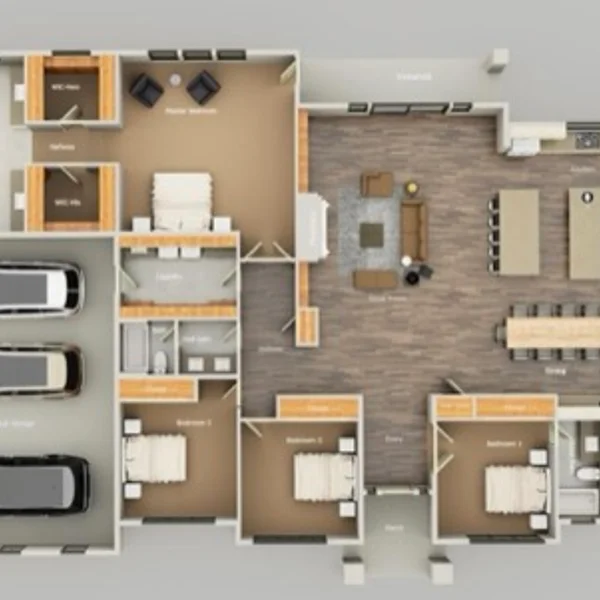
In this model, the builder provides a curated portfolio of pre-designed architectural plans. These layouts are professionally developed, structurally optimized, and refined through previous builds to ensure functionality, efficiency, and construction reliability.
Rather than designing from zero, the homeowner selects a foundational plan that already performs well in terms of flow, proportion, and engineering feasibility.
From there, customization is introduced in a controlled and strategic way.
Personalization Within a Proven Framework
Semi-custom homes allow homeowners to personalize key design elements without the complexity of full architectural development.
Common modifications include:
Expanding or reconfiguring kitchen and living spaces
Upgrading materials such as natural stone, hardwood, or custom millwork
Enhancing outdoor living areas and landscape integration
Selecting high-performance appliances and smart home systems
Adjusting interior finishes to reflect individual aesthetic preferences
This approach preserves the integrity of a proven structural design while still offering meaningful personalization.
Key Differences: Experience, Timeline, and Decision Load
The distinction between custom and semi-custom construction extends beyond design flexibility—it fundamentally shapes the homeowner experience.
A fully custom home offers maximum control but requires sustained engagement across all stages of development. It is ideal for those with a highly specific vision and the time to actively participate in the process.
A semi-custom home, on the other hand, prioritizes efficiency, predictability, and reduced decision complexity. It is well-suited for homeowners who want architectural quality and personalization without managing every technical detail.
From a project execution standpoint, semi-custom builds generally offer shorter timelines, more predictable budgets, and streamlined permitting processes due to standardized plans.
Choosing the Right Path
The decision between custom and semi-custom construction ultimately depends on lifestyle, priorities, and tolerance for complexity.
If your vision demands architectural uniqueness, site-specific innovation, and complete creative control, a fully custom home provides the necessary freedom.
If your priority is achieving a refined, high-end residence with curated customization and a more structured process, a semi-custom approach delivers a balanced solution.
In both cases, success depends on early planning, clear decision-making, and collaboration with experienced design and construction professionals who understand the nuances of Northern California’s regulatory and environmental landscape.
Final Perspective
Whether fully custom or semi-custom, building a luxury home in Northern California is not simply a construction project—it is a strategic investment in lifestyle, comfort, and long-term value.
When guided properly, both paths lead to the same outcome: a personal sanctuary designed to reflect how you live today, and how you want to live for decades to come.